
Sports timing systems, from photo-finish to handheld
How sports timing methods work — fully automatic timing, photo-finish, transponder chips, and manual timing: their cost, accuracy, and when a stopwatch fits.
Every sports result — from an Olympic 100 m record to Tuesday's swim practice — comes from one of a handful of timing methods. They differ enormously in accuracy, cost, and setup effort, and none of them is "best": each owns a range of events. This guide maps the methods, from fully automatic systems down to the handheld stopwatch, and shows where each one is the right call.
The timing spectrum
Sports timing methods sit on a spectrum defined by one question: how are the start and finish events detected? At one end, machines detect both — a start gun wired to the system, a camera or touchpad at the finish. At the other end, a human detects both with eyes and thumb. In between sit hybrids where a machine handles one side and a person the other. As detection gets more automatic, accuracy and capacity rise — and so do cost, setup time, and the size of the crew needed to run it. Even the most automated systems, it is worth knowing, still keep a small human staff on site to supervise the equipment and flag events the machines cannot judge, such as false starts.
Fully automatic timing and photo-finish
Fully automatic timing (FAT) is the standard for record-eligible competition in sports like track and swimming: the clock starts from a sensor coupled to the starter's gun and stops from a machine-detected finish, with no human reaction time anywhere in the chain. At the finish line, the workhorse is the photo-finish camera — a line-scan camera that photographs a single sliver of the finish line thousands of times per second and assembles the strips into an image where the horizontal axis is time. Judges read each athlete's torso off that image to the thousandth of a second. In pools, touchpads on the wall play the same role, backed by cameras.
Accuracy is effectively absolute for sporting purposes — 0.01 s results derived from 0.001 s captures. The price is professional-grade everything: equipment from the low thousands of dollars for an entry photo-finish setup to far more for a championship installation, trained operators, and per-event setup. At the elite end the field is dominated by long-established specialists — Omega and its Swiss Timing service arm have run Olympic timing for decades, and every major sport has a small circle of comparable providers, often carrying a luxury watch brand's name for marketing while specialist engineering firms build and run the actual systems. For schools and clubs, FAT matters mainly at championship meets where records and close finishes must hold up; it is rented (with its crew) far more often than owned.
Transponder and chip timing
Road races, triathlons, and mass-participation events have a different problem: not resolving a photo-close finish, but capturing thousands of finishers. The answer is transponder timing — each athlete carries a small RFID chip (in the bib, on a shoe, or on an ankle strap), and antenna mats or side antennas at the start, finish, and checkpoints record the exact moment each chip passes. Because every athlete carries their own identity, the system delivers both gun time and net time, plus intermediate splits wherever a mat is laid.
Chip accuracy is typically in the 0.1–0.3 s range — an order of magnitude coarser than photo-finish, which is why track sprints are never chip-timed, but far better than any human could manage for a field of ten thousand. The economics are service-based: race organizers hire one of the many regional timing companies, which bring the mats, chips, software, and live-results publishing as a package, usually priced per participant plus a base fee. For any event too large to read names off a finish line, this is the category — and there are established professional providers serving every region and race size.
Semi-automatic timing
Between the machines and the stopwatch sits a family of hybrids: one end of the measurement is automatic, the other manual. Classic examples are a hand-operated finish button feeding a system that took its start from the gun sensor, swim meets where each lane's timekeeper presses a plunger backed by (or backing up) the touchpads, and photocell gates — light beams the athlete breaks — that are started by hand for training sprints. Semi-automatic setups inherit a human reaction time on exactly one side, so results are honest to roughly a tenth of a second, and rulebooks treat them accordingly (hand-influenced times get rounded up and excluded from records). Their virtue is cost: a set of photocells or plungers is a fraction of a FAT installation and dramatically upgrades a club's training measurements.
Manual timing
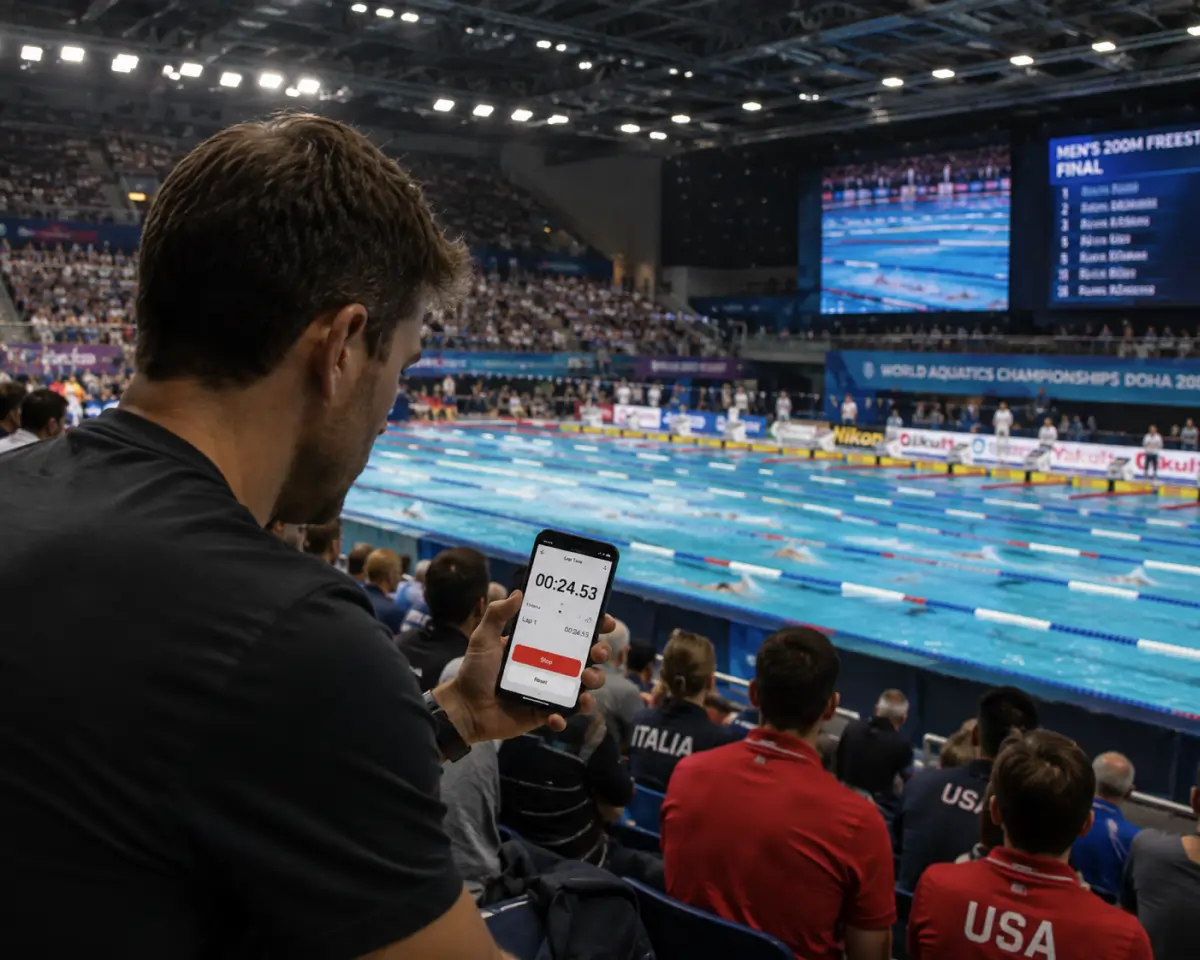
Manual timing — a human, a stopwatch, and a thumb — is the oldest method and still the most used one on any given day, because training sessions outnumber championships thousands to one. Its accuracy is bounded by human reaction time: individual times carry roughly ±0.2 s, which is why hand times are recorded to the tenth and never set records. But for the questions coaches actually ask daily — is the pace right, did the last repeat fall apart, is this athlete faster than last month — that resolution is entirely sufficient, and no other method matches its cost (a stopwatch or a phone), setup time (zero), and flexibility (any sport, any venue, any distance, mid-session changes included).
Manual timing also survives alongside automatic systems, for three practical reasons: a coach in the stands has no tap into the official system and wants splits in hand the moment they happen; automatic systems only measure at fixed detection points, while a coach can catch a split anywhere on the course; and some data — stroke rate, stride cadence, tempo counts — is not a timing-system output at all, but something a coach layers on top of the watch.
Matching the system to the event
- Records, championships, sprint finishes — fully automatic timing with photo-finish or touchpads. Rent it with a crew; established providers exist at every level, from national federations down to regional meet-services companies.
- Mass-participation road races and triathlons — transponder/chip timing from a regional timing service, priced per head.
- Club competitions and testing days — semi-automatic: photocells, plungers, or button-finish systems that buy back most of the accuracy at a small fraction of the cost.
- Daily training, school sport, small meets, and every coach's own record — manual timing. This tier is not the fallback; by volume, it is where most of the world's sports timing happens.
Where a multi stopwatch fits
The weak point of manual timing was never the accuracy — it was capacity. One stopwatch times one athlete, so a coach with a training group ends up with a fistful of watches, a notepad, and eyes on a screen at exactly the wrong moments. That specific gap — manual timing of multiple athletes by one person — is what a multi stopwatch exists to close, and it is the problem Herotime's patented single-button method was built for: one tap per event, automatic assignment of every split to the right athlete, and a digital history instead of the notepad (US Patent 11,080,947 B2 — see how it works).
To be equally clear about the boundaries: a multi stopwatch is still manual timing. It will not time your city marathon, adjudicate a photo-close final, or set a record. If you need those, hire the professionals above. If you are a coach, a teacher, or a club timekeeper who needs every athlete's splits from today's session — that is the job it wins.